
DRACULA, PRINCE OF PONCHA?
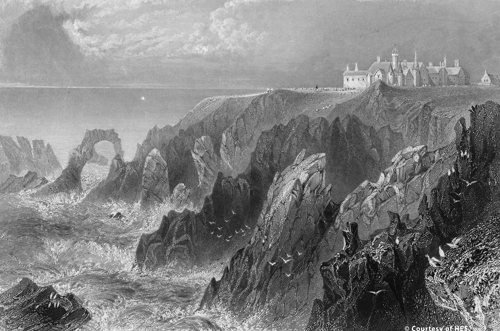
An artistic impression of Slains Castle in its earlier grandeur, captured before it fell into ruin.
“Writers go to extreme lengths to come up with a biting narrative, straying from the marker buoys of credibility. This time, I was surprised to discover how close to the truth I’d inadvertently sailed!”
The Dracula franchise we know and continue to lap up sprang from a Gothic conceit conceived in the Aberdeenshire village of Whinnyford and the neighbouring village of Cruden Bay, where its author, Bram Stoker, spent his summer holidays in the late nineteenth century.

Slains Castle became a ruin after financial troubles forced the Earl of Erroll to sell it in 1916. In 1925, the roof was removed to avoid taxes, leading to its current state as a roofless shell above Cruden Bay Golf Club.
TWO HOLES WITH THE COUNT
It was in this stark Scottish coastal landscape, punctuated by the fractured outline of Slains Castle, ragged cliffs and rolling North Sea mists, that Stoker found the inspiration that would shape a legend.
I often play golf at Cruden Bay Golf Club and once wrote a story about encountering a mysterious, enigmatic gentleman on the 3rd tee, who accompanied me for two holes as we strolled toward his clifftop citadel perched high above the par-3 5th.

Slains Castle looks over Cruden Bay’s 4th & 5th holes with the enchanting fishing village of Port Errol in between.
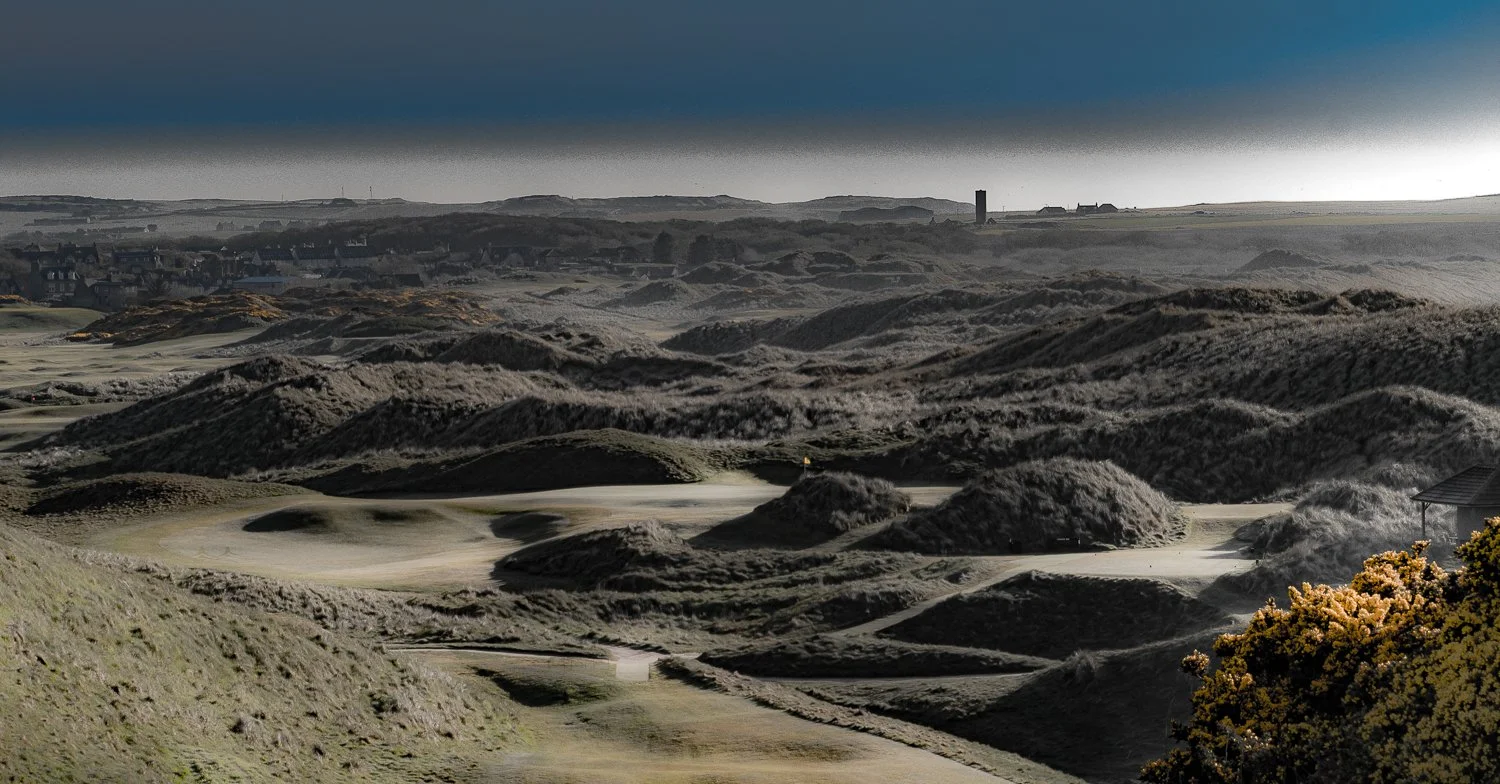
An eerie outline of Cruden Bay Golf Club - watch out for the bats.
KILMARNOCK ARMS
On those regular visits, I stayed at the Kilmarnock Arms Hotel, where Stoker also quartered, albeit a century and a half earlier, as confirmed by the hotel’s register. The hotel’s owner, by the way, is called Lucy!

Here’s Lucy! The hotel’s guest book from 1894 includes Stoker’s signature.

Stoker discovered Cruden Bay on a walking holiday to Aberdeenshire in 1893, writing: "When first I saw the place I fell in love with it." He returned in 1894, booking into the Kilmarnock Arms Hotel and writing in the hotel’s register: "Second visit to Port Erroll. Delighted with everything & everybody & hope to come again to the Kilmarnock Arms."
HENRY THE GERMAN
So, how do I weave this winding, windbag of a tale back to Madeira?
In my Madeira Travel Stories, I wrote about ‘Henry the German’ and that he maybe was King Władysław III of Poland, Hungary & Wallachia and that he was maybe Christopher Columbus’s father. That’s a couple of seriously controversial ‘maybes’ that collide directly with perceived history. But work with me a while...
“If the above two ‘maybes’ are true, then there is a connection between Madeira and the legend of Count Dracula!”
Bram Stoker’s inspiration for the character of the “dark prince” of despotism and dental aberration is widely acknowledged to be Vlad III of Wallachia, a fifteenth-century ruler of the principality, which at the time existed precariously between Hungarian influence and Ottoman suzerainty.
Although Vlad did not rule Transylvania, the region lay adjacent to Wallachia and figured prominently in the historical and folkloric milieu from which Stoker drew. The name ‘Dracula’, by the way, comes from Dracul (Dragon), referencing Vlad’s father’s order. Dracula simply meant “son of Dracul.”
Following the Battle of Varna in 1444, Władysław III vanished without a trace, leaving a power vacuum that plunged the region into political instability and widespread violence.
“Władysław’s disappearance left Vlad III a fractured geopolitical landscape marked by betrayal, hostage-taking, and endemic violence—conditions that profoundly shaped his rule.”
VLAD THE IMPALER
Known to history as ‘Vlad the Impaler’, he governed through extreme brutality, including mass impalement, not as an expression of madness but as deliberate psychological warfare on the brutal frontier that existed between the Ottoman Turks and the Christian crusaders.
According to tradition, King Władysław survived Varna, sought penance in Jerusalem, and resurfaced almost ten years later in Madeira, where he lived under the name Henrique Alemão (“Henry the German”).
Henrique Alemão is a real, documented individual who was wealthy, educated, deeply religious, and deliberately silent about his origins. He lived in Madalena do Mar, a small coastal village on the south-west coast of Madeira, withdrawn from politics and avoiding lineage claims. You can read more about him here…
Centuries later, Bram Stoker appropriated the name “Dracula” for his Gothic antagonist, largely severing it from its political and historical context and transforming it into one of the most enduring and unsettling figures in Gothic literature and modern cinema.
“As I noted at the beginning of this article, writers will go to almost any length in pursuit of a story that bites.”
There is no hard evidence that Vlad the Impaler ever came to Madeira to confront his vanquished king—the man whose disappearance helped fracture the world Vlad had inherited.
But had he done so, he might have developed a taste for poncha rather than his penchant for blood, and history would have been robbed of one of its most enduring and blood-curdling myths.