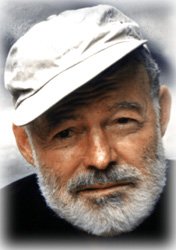
Hemingway in Madeira
“A couple of famous characters showed up at Madeira’s shores... and never actually set foot on the island!”
Napoleon Bonaparte was one, on his way to exile on the remote South Atlantic island of St Helena. Rumour has it that the British Consul at the time, Henry Veitch invited the ex-Emperor to visit the island, very much against the orders of his British captors!
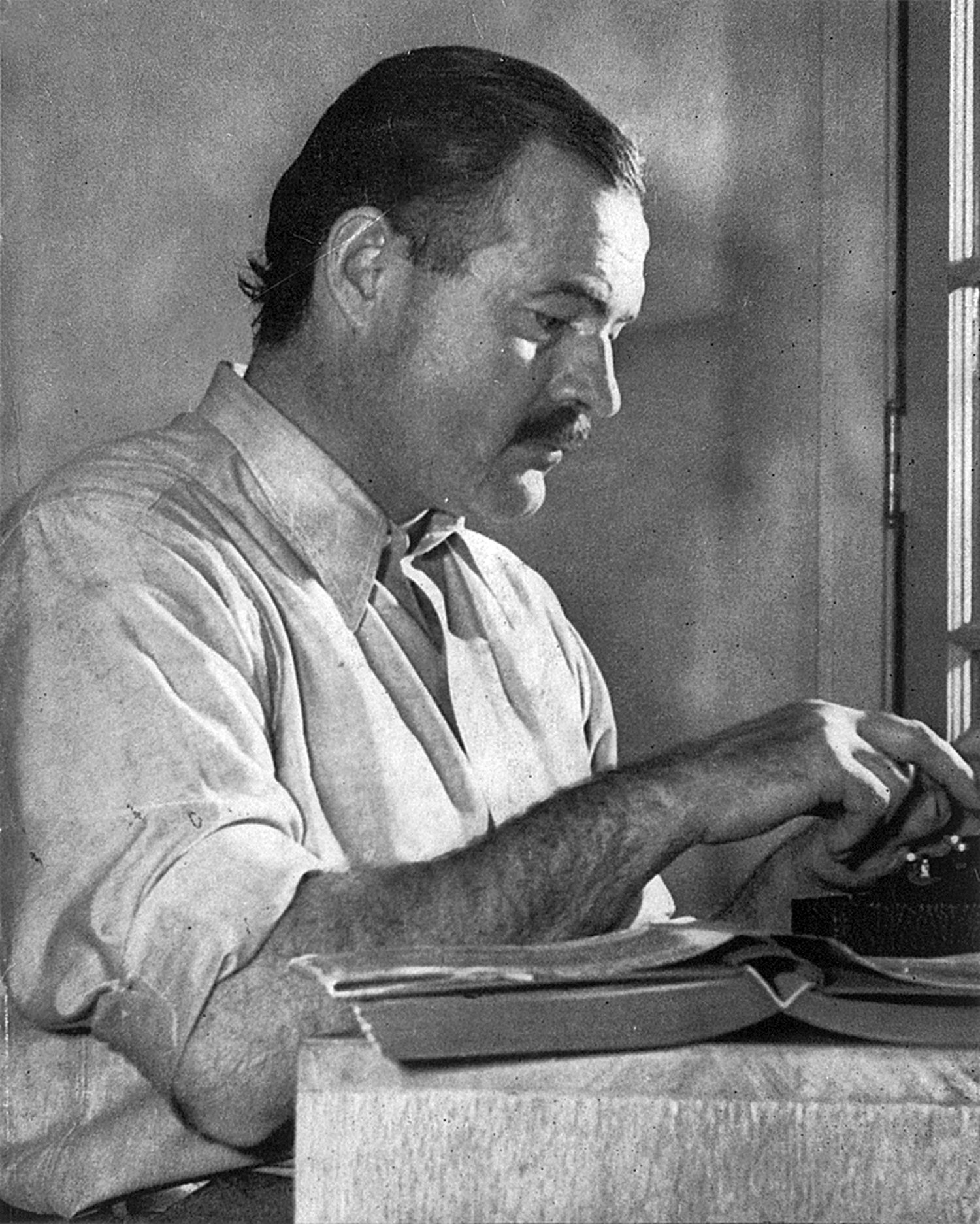
Hemingway’s style is famously simple, direct, and deceptively powerful, which in some ways reflects his character and entire approach to life.
THE IMPORTANCE OF BEING ERNEST
The other is Ernest Hemingway! The author and his fourth wife, Mary, sailed into Madeira in 1954; that much we do know. But there’s very little detail about the author’s visit, and it’s unclear if he even got off the ship!
Let’s take a closer look…
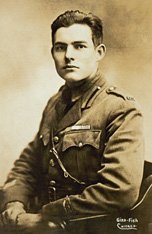
Ernest Hemingway, the WWI Ambulance driver
TWO WORLD WARS
Ernest Hemingway was a larger-than-life character, a machismo mix of John Wayne and Genghis Khan!
The young Midwesterner displayed innate bravado at the age of 18 when, at the outbreak of World War I, he volunteered to drive an ambulance for the Red Cross on the Italian front.

Hemingway in an American Red Cross hospital - 1919
A year later, an Austrian mortar shell exploded near the volunteer’s vehicle, causing him more than 200 shrapnel wounds.
Despite his own significant injuries, Hemingway dragged a wounded Italian soldier to safety. He was awarded the Italian ‘Silver Medal of Bravery’ for his action, one of the first Americans to be so honoured.
After a 6-month layup in an Italian hospital, he was invited by a friend to stay on the island of Madeira to further recover from his wounds. Madeira’s ‘sun & air’ had long been recognised for their recuperative powers.
But Hemingway declined and returned to his parents’ home in Oak Park, Illinois, on the northwest corner of Chicago (a place I know as one of my pals lives in that neighbourhood).

Hemingway’s parent’s home in Oak Park, Illinois is now a museum dedicated to the author.
WORLD WAR II
Hemingway was already in his forties when WWII broke out and his novel ‘For Whom The Bells Toll’, based on his Italian experiences, was already a success.
The writer travelled to London in the spring of 1944 to take up a post as a war correspondent for the weekly ‘Colliers Magazine’, then on to France. He got into the thick of things, flying missions with the RAF, boarding the landing craft to Omaha Beach on D-Day and becoming actively involved with the French Resistance!
“As far as his ‘war correspondents’ duties, he kept those to a minimum! He sent back only 5 reports during the entire period, just enough to keep him in Europe. ”
Much against the Geneva Convention, which disallowed civilians to take up arms, Hemingway actively and directly involved himself in the war effort. He was decorated with the Bronze Star Medal, the highest military award available to a civilian.
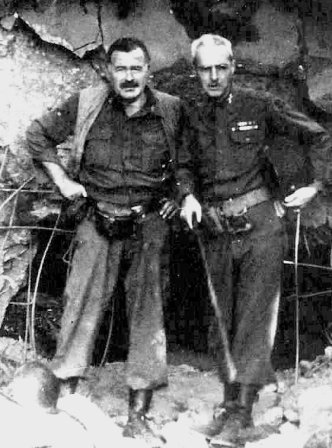
Hemingway and Col. Charles T. Lanham in Germany 1944.
OUT OF AFRICA

Ernest and Mary Hemingway on safari in Kenya, Africa, 1953-1954, where they were involved in not just one but two consecutive aeroplane crashes over two days, resulting, in the writer’s case, in significant injuries that would affect him for the rest of his life.
After the war, Hemingway produced several important works: “The Garden of Eden” (written in the late 1940s and published posthumously), “Across the River and Into the Trees” (1950) and “The Old Man and the Sea” (1952).
Although not everything he wrote in these years was well-received, he kept working, splitting his time between Cuba (his main home), Key West, Florida, Paris, Venice and Spain (especially during bullfighting season).
With Mary, he also spent long periods travelling, hunting and fishing, activities that became central to his writing.
A SIGNIFICANT YEAR
On January 23rd 1954, during a sightseeing flight over the Murchison Falls in Uganda, their small plane hit a utility pole and crash-landed in the jungle.
They survived but were injured. The very next day, while attempting to reach medical care, they boarded another small plane that caught fire and crashed on takeoff in Entebbe.
Hemingway suffered burns, internal injuries, a fractured skull and spinal compression, injuries that would affect him for the rest of his life. Over several weeks, he recovered in Nairobi and Venice but decided to return to Cuba to recuperate in their main home.
HEMINGWAY IN MADEIRA
On June 15, 1954, Hemingway and Mary arrived at the island of Madeira aboard the Italian ship ‘Francesco Morosini’. According to Mary’s memoirs, she drank Madeira wine, visited the chapel of Emperor Karl I in Monte and took the famous toboggan ride back to town. There was no mention of her husband partaking in any of these activities.

A WORK OF FICTION
However, an article appeared in the Funchal newspaper the very next day claiming that the famous writer had disembarked and spent time with a ‘most fortunate’ journalist!
In it, the journalist waxes lyrical about Mr Hemingway’s books, literary style and war experiences, which were, of course, all well documented. But there’s no discussion at all about his actual Funchal visit!
“There was a mention of the journalist’s attempt to interview the writer on the ship only to be told, “Mr Hemingway does not receive gentlemen of the press.” ”
The spurious tale goes on to say that the journalist and a photographer met Mr Hemingway by a pool in Funchal and that he had come down the mountain in ‘one of the native carts’.
It seems to me the journalist was taking liberties to get his story! For instance, where are the photographer’s images? How come there is no mention of Hemingway’s impressions of the island, etc?
One can only assume there’s a high degree of artistic license at work… a work of fiction indeed. This is rather ironic given Hemingway’s economic style and deliberate omissions to create meaning with the fewest possible words. I suppose journalists needed to fill in column inches - even in those days. And besides that, every day is a slow news day in Madeira…
Long may it last…!