
The Scottish Borders
“The Scottish Borders have never been much of a golf destination. ”

Selkirk might be built on the side of a hill but it offers the most incredible Border views.
I caused a bit of 'stooshie' (a Scottish word for stramash which is another Scottish word for a civil disturbance), when I wrote in Golf Monthly magazine that I had watched a group of hillwalkers walking over Selkirk Golf Club complete with backpacks, billie cans and woolly hats.
My article attracted a fairly robust letter of condemnation from the club secretary at the time, who insisted I had delivered a poor impression of his course. But I had only recorded what I saw. As I teed up on one of those sloping hillside holes, I watched a group of hikers calmly cross the fairway before me on their way to ascend Selkirk Hill.
There was another Borders stramash in a different edition of the same magazine. One of my photographs from St Boswells Golf Club showed a member teeing off with his trousers tucked securely into his socks. The course was soaking underfoot that day, and the poor fellow was simply protecting his cuffs. (Plus Fours suddenly seemed a rather sensible option.)
Nevertheless, a spirited debate on “correct dress etiquette” filled the Readers’ Page for the next three issues.
I began to suspect that the Scottish Borders did not so much invite aggravation as cultivate it.

St Boswells is a picturesque Borders course on the banks of the Teviot.
BUFFER ZONE
This part of Scotland has been attracting fracas far worse than my little editorial upsets, stemming from the fact that, for centuries, the Scottish Borders acted as a crash barrier between two highly contentious, continually bickering neighbours, Scotland & England!
Between the late 13th century and the Union of the Crowns in the 17th century, the two constantly warring nations turned the Borders into a virtual no-man’s-land, a lawless state full of cattle thieves and brigands, so much so that the locals had to take matters into their own hands and patrol the perimeter of their town or region. They still do this in several Borders towns during annual celebrations called ‘Common Ridings’!
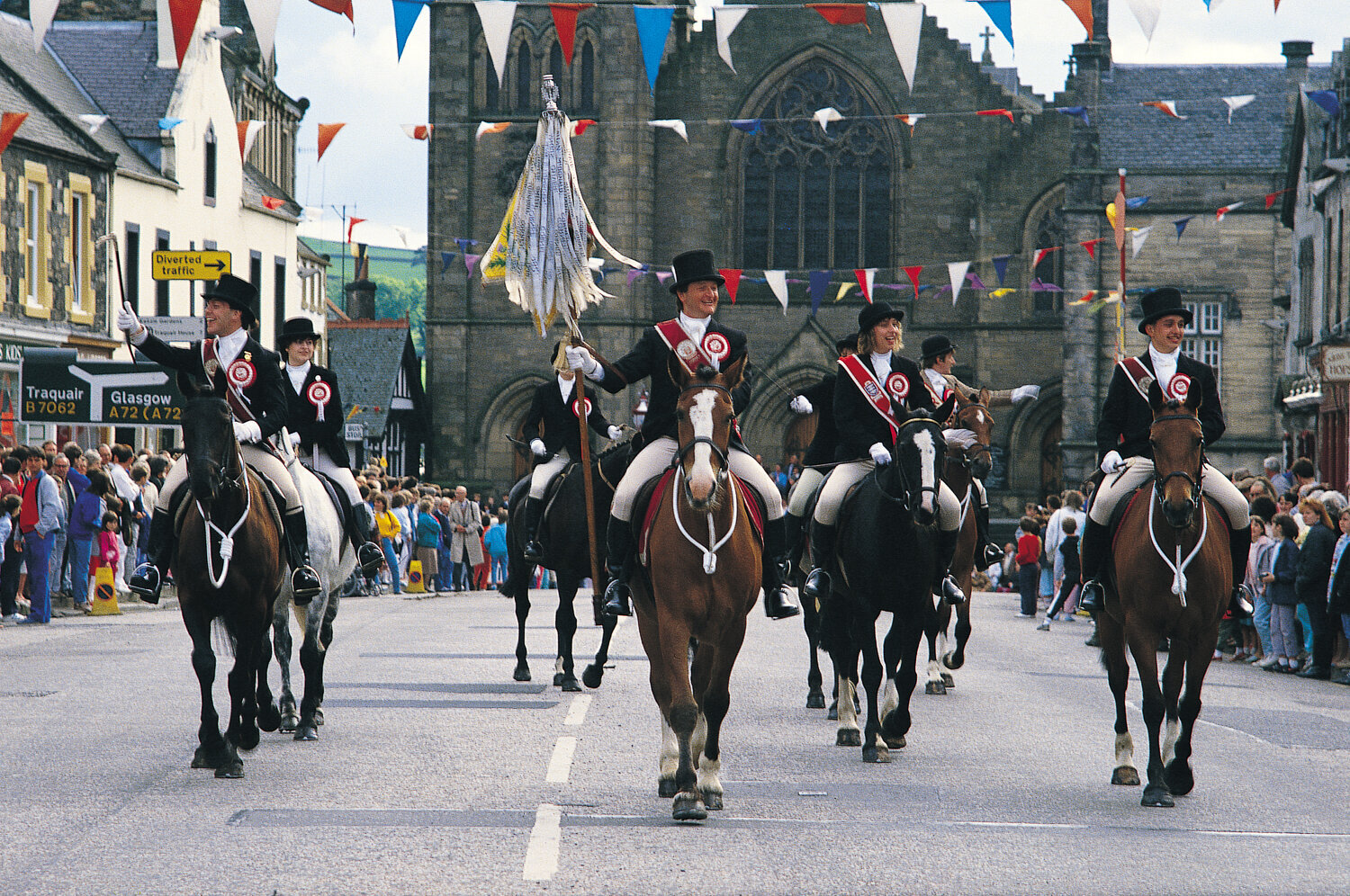
The bonny lads & lasses of Peebles head out on the ‘Riding of the Marches’, patrolling the town’s perimeter.
By contrast, the Scottish Borders today is one of the most peaceful parts of Scotland. It’s especially scenic with rolling hills, glistening rivers and unspoilt villages; a paradigm of tranquillity. In the east, quilted landscapes flow down to meet coastal communities such as Eyemouth, St Abbs or Coldingham. The west side of the region, beyond the town of Peebles, is far more remote and wild.
PUT OUT TO PASTURE
For this and several other lofty reasons, golf came late to this turbulent corner of the land! Rugby and fly fishing were the Border’s more popular pastimes. Golf was considered for older lads who had passed their ‘fly-half’ prime (rugby speak) and were no longer fit enough to bring down a ‘blindside flanker’ (more rugby speak). Like the sheep, they were put out on the sides of the many Border hills - to pasture and to play golf. And that’s where I got into trouble for saying some of the Border courses were a bit hilly!